Karkaraly National Nature Park
Достопримечательность
Karkaraly National Nature Park was established on December 1, 1998 by the Decree of the Government of the Republic of Kazakhstan No. 1212.
The territory of the national nature park belongs to the second category of specially protected natural areas that have the status of an environmental and scientific institution of national significance. Bis intended for the conservation of iological and landscape diversity, Мемлuse for environmental protection, environmental education, scientific, tourist and recreational purposes of unique natural complexes and objects of the eco-reserve fund (GTOS), which have a special ecological, scientific, historical, cultural and recreational value.
The Karkaralinsk-Kent mountain junction consists of five relatively isolated mountain groups: Buguli, Shankoza, Maten, Ayyrtau and Kent. The Karkaraly Mountains and the Kentish Basin have a noticeable landscape asymmetry: their northern slopes are steeper than the southern and western ones, and are rich in springs and vegetation. These are ridges that form a network of mountain ranges and peaks separated from each other by deep gorges, inter-mountain valleys, and hollow low-lying plains. The Karkaraly valley consists of a narrow period and the Akpet, Bulyk and Ayyr ridges and individual peaks of Zhyren Boroda (1403m), Shankoz (1360), Bulyk (1323), Koktobe (1254) and a number of low-altitude ridges.
The territory of the district is characterized by a wide distribution of river valleys, natural meadows and lake basins, as well as small flat hills.
The climate in the territory under consideration as a whole, as in all small hills, has a sharply continental, anticyclonic weather regime, which is characterized by the severity of the winter season, cold summer, significant fluctuations in daily and annual temperatures, frequent recurrences of drought, dry winds and cloudy days.
The flora of the Karkaraly GNPP includes 198 species of indoor plants, 3 species of ice, 2 species of plants of the centipede family, 27 species of mosses, 14 species of lichens currently registered, although according to literature sources their number can reach about 800 species. This is three times more than in the adjacent steppe zone. 5 out of 244 species are included in the Red Book of the Republic of Kazakhstan: Karkaraly barberry, smooth peat moss, Kirghiz birch, thin poppy, spring Zhanargul. The flora of Karkaraly and settlement t-forests contains a large number of endemic and boreal plants.
Rare and endangered plant species include: Karkaraly wheat, Karkaraly barberry, thin, all-pervading, winter-hardy tentacles, green pear, round-leaved pear, leafy gill, Kazakhstan jasmine, Siberian thyme, spring minuartsia, zhigul daragul, red fescue, aidarbena dymlyankovidnaya, ribbon rosemary, Fuchsia ground squirrel, sholpanshash sumbil, blue gelaidar, common kargakoz, Kamchatka nest, pallas ushkat, granary rod, common jackal, Zalessky Boz, white seleu, common sarytun, white abyss, leafless lark, common fern, naked wormwood, false licorice, sphagnum bruised, recumbent tulip, sand king, male usyr, Karkaraly saldyrbab, Kurt-chash, carnation spurge, Kurt-chash, open kestezhusan, gelaidar, forest gelaidar, Circe alpa, light violet, chyna zhatagan, Asian Botacoz, tender poppy, etc.
There are 46 species of mammals, at least 234 species of birds, 6 species of reptiles, 2 species of amphibians and 15 species of fish on the territory of the Karkaraly SSPP. The insect fauna is poorly understood, and currently there are no exact data on its species composition.
The mammalian fauna is based on rodents-red partridge, gray marten, Baybak partridge, field mouse, big clubfoot, jumping clubfoot, Zhetysu clubfoot, Eversman clubfoot, common alaman, Streltsov's vole, muskrat, Steppe palm, water clubfoot, common mouse, narrow-gauge mouse, forest mouse, house mouse, small bokeser.
Predators include wolves, foxes, moose, badgers, skunks, white mice, stoats, and lynxes. Until 1940, bears were found on the territory of the GNPP. Ungulates include the largest mammals: wild boar, maral, Siberian roe deer, elk, Argali.
The territory of the national park is a habitat for Kazakhstan mountain argali sheep. This species is listed in the Red Book of Kazakhstan, category 3 status. It is included in Annex 2 of the Convention on International Trade in Endangered Species of Wild Fauna and Flora. Among the most widespread species, a group of rare birds of prey is represented everywhere-Golden Eagle, owl, Steppe Eagle, Thrush, Bakaltak Eagle, steppe kuikentai, snake Eagle, Thrush. Taztyrna breeds in swampy rivers. Among the animals listed in the Red Book of the Republic of Kazakhstan, the national park is home to: Argali, Sabanchi, taztyrna, white-headed crane, black degelek, curly ramazan, whispering swan, Falcon swan, Golden Eagle, Thrush, Steppe Eagle, owl, Bakaltak Eagle, Sunkar-itelgy, bronze, Steppe gray snake, shakildek.
In accordance with the Resolution of the Government of the Republic of Kazakhstan dated November 18, 2010 No. 1212 "list of geological, geomorphological and hydrological objects of the State Nature Reserve Fund of national and international significance", the SMMP includes the following objects:
Geological features
- The White Bear Mountains (Ayushat) is a granite mountain located northwest of Kenderly Lake. At the summit, there is a free-standing peak with small cone-shaped stone hills between the green Kenderly Valley. The mountain got its name from the fact that it once looked at the bears that lived on its slopes.
- Buguli Mountain, high hills at an altitude of up to 1100 m above sea level, is covered with birch and aspen groves and dogwood bushes.
- Mount Zhirin-boroda, Karkaraly Highlands-the highest point in the forest area-is made of granite at 1403 m and has three peaks.
- Mount Koktobe, a cone-shaped mountain with a height of 1254 m, with panoramic views similar to Mount Kilimanjaro.
- Mount Tar-period, a low mountain range that crosses the valley in which the city of Karkaralinsk is located from the Kendara Valley.
- Mount Shankuz is 1200 m high and volcanic, like an extinct crater.
- Kalmyk Rampart, an artificial structure built in the form of a long chain of stones, passes through the outskirts of the city of Karkaralinsk and goes deep into the forest.
Geomorphological
- The cave "three caves" has cultural and educational significance-a cave consisting of three parts with an area of 1 hectare.
- The stone Tong "Grand Chamber" represents the cultural and educational essence. The small cave has cultural and educational significance, is one of the most visited places by tourists since the foundation of the city.
Hydrogeological properties
- The site of the Sphagnum swamp, a small plot of 0.3 ha located in the north-western part of the city of Karkaralinsk, is of interest for the growth of plants listed in the Red Book – flat sphagnum. This is the growth point on the southern side of Kazakhstan where this plant grows.
On the territory of the national park there are such objects of historical and cultural heritage as Kzyl-Kensh Palace-an archaeological monumentI (Kentish forestry) and the forester's house-a forester's house in the Komissarovka tract (Karkaraly forestry), built in 1914. In the village, on an area of 30 hectares, the remains of residential buildings of the early Bronze Age – the Begazy-Dandybay culture-have been preserved. This center is the largest settlement in Kazakhstan in this era. The population of this culture occupied vast expanses of Kazakhstan, the forest-steppe zone of Western Siberia and the Steppe Altai.
In addition, the" list of subsurface areas of special ecological, scientific, cultural and other value classified as specially protected natural territories of national significance " of the State Research Institute of Natural Resources includes the following subsurface areas: mount "Zhiren Boroda", cave "three caves", artificial structure "Kalmyk Val", "Big Chamber" Kamennaya cave, lake" Kamennaya skazka", lake" Shaitankol", a section of the Sphagnum swamp.
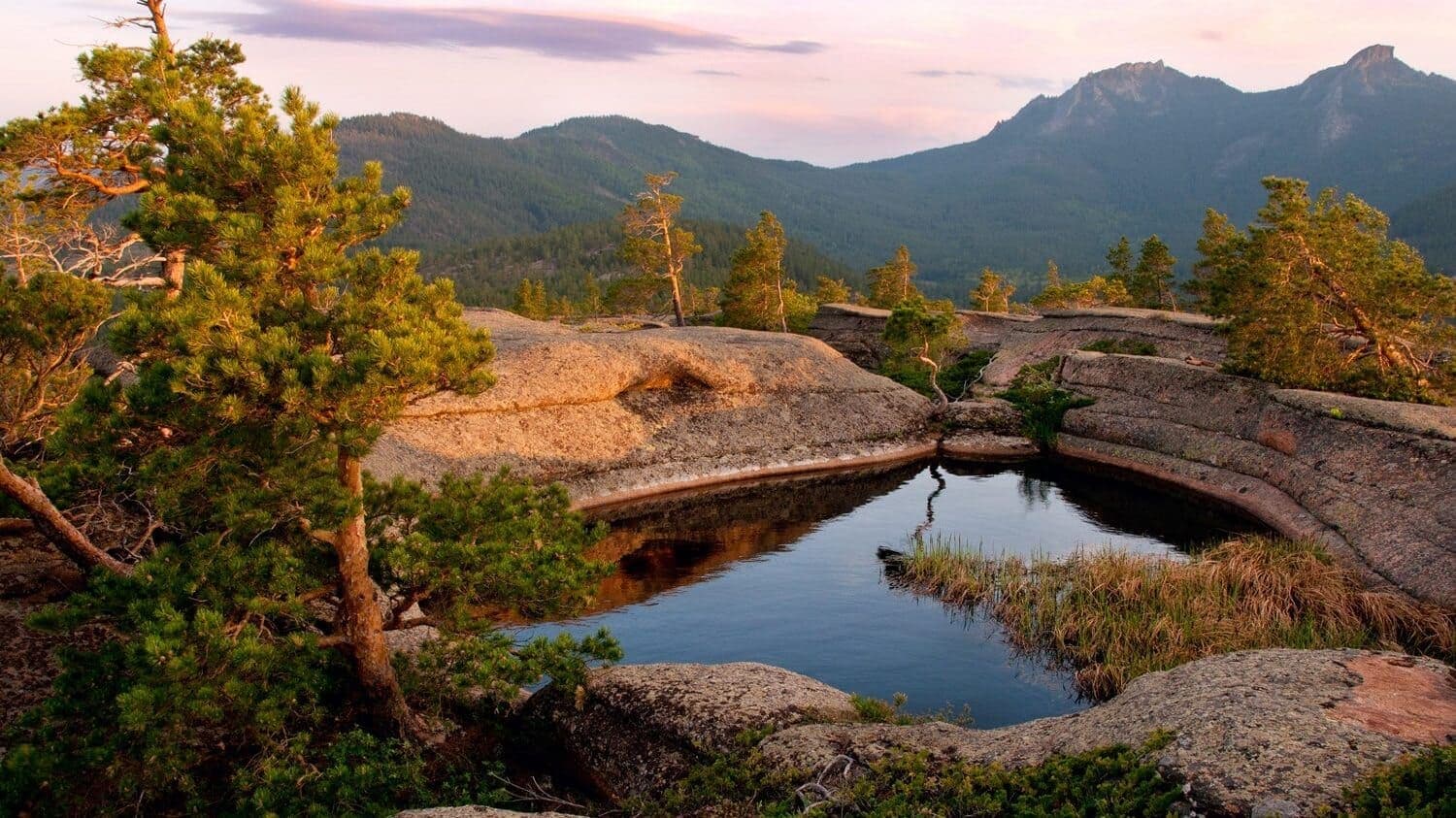
Lake "Shaitankol". The total areais0.4 ha. Unique hydro-geological formation at an altitude of 1200 m above sea level.
Lake "Kamennaya skazka". The total area is 0.14 ha. Unique hydro-geological formation at an altitude of 1200 m above sea level.
For communication:
Reception: 872146-31214
Fax: 872146-31214
Tourism Department: 872146-32852
Email:
Science Department - monitoring12@bk.ru
Tourism Department - o_turizm@mail.ru
Home Electric Mail - karkaraly_oopt@inbox.ru
Website: karkaralinskpark.kz